






I don’t remember which of Shakespeare’s plays I read first, but I do remember the first performance I watched, start to finish: it was Kenneth Branagh’s Henry V, playing on the TV when I was eleven and my dad was deployed in Desert Storm. I didn’t understand everything that was going on, and couldn’t have if I’d only read it. But because performance can energize and interpret the play for me, in specific ways, I was able to understand this play was about war, and it was about why men fight in wars. The monologue that made an unforgettable impression on small Tessa wasn’t from the Crispin’s Day speech. It was one spoken by a soldier with whom the king is conversing about the just nature of his war. Given the quagmire of wars American has been involved in since 2001, I could analyze this now with rather depressing politics, but as a child all I heard was why are we fighting this war? If my dad dies, what will it be for? The performance drew out the meaning of the speech even for my unprepared ears. I hadn’t thought to ask why before, and the performance taught that question.
I wish everyone were introduced to the Bard via great performance instead of being forced to read it, without the context of audience and energy, and usually by untrained voices. Because a capable performance changes everything.
“Tomorrow, and tomorrow, and tomorrow,
Creeps in this petty pace from day to day,
To the last syllable of recorded time;
And all our yesterdays have lighted fools
The way to dusty death. Out, out, brief candle!
Life’s but a walking shadow, a poor player,
That struts and frets his hour upon the stage,
And then is heard no more. It is a tale
Told by an idiot, full of sound and fury,
Signifying nothing.”
In print this soliloquy from Macbeth is a lovely poem that’s an extended metaphor about life and death and time. It can be analyzed like any literature: the words alone are so open to interpretation. But when performed with a bit of a sneer and some sarcasm, suddenly it’s a scathing indictment of common values. If delivered slowly, with woe and tears, it’s mournful and sweet… or possibly even horrifying and full of existential dread! In the play, Macbeth says these words right after hearing his beloved wife, who drove his ambition to greater heights, is dead. How does that change our understanding of the poem? How does a sneering delivery change our understanding of Macbeth and how he feels about the situation? Or if he is tearful, crying, what does that say?
Production matters so much: the director, actors, set, the audience participation via thrust stage or breaking the 4th wall, the awareness of context and choices. This is why we’ve been interpreting and reinterpreting Shakespeare’s plays for 400 years. He gives us a common language with which to interrogate ourselves in our own context.
Until recently, I thought Romeo and Juliet had nothing to offer me but beautiful poetry. Though I enjoy Baz Lurhman’s Romeo + Juliet for its cast and modern vision, it didn’t teach me anything new about the play, or about myself and my own context. Harold Perrineau’s amazing Mercutio aside, it’s still just a story about kids who fall in love while everybody around them makes terrible choices. Every production I’ve seen has moments of brilliance or beauty, but they all leave me cold because the central conflict has no bearing on my life.
Then I saw Private Romeo, a 2011 film that sets the play (rather messily and haphazardly) in an all-boys military academy. It creates a new context for the famous lovers—gay soldiers during the era of “don’t ask, don’t tell”—and it blew my mind (and my heart) because it took all that beautiful poetry and intense emotion, the mistakes and conflict, and made it relevant to my context. Here is my favorite scene from the movie, the “palm to palm” meeting. When two young men attending a military academy, in 2011 America, flirt and kiss over words such as “sin from my lips” and “give me my sin again” the entire meaning of the play shifts!
The reinterpretation doesn’t have to be complete to be affecting. I’ve seen many Hamlets, and pieces of each performance changed me (yes, even Mel Gibson, whose dark, manic leaping-about upon tables and watery eyes first gave me a way to understand that the Danish Prince was as confused about his life as I was). In college I rented Branagh’s epic Hamlet and watched it one Friday afternoon when my roommate was out of town. The next day, I watched it two more times, because I finally, finally understood the grandiose nature of the play, the questions it was asking, and Kate Winslet’s Ophelia was layered and complicated, especially regarding her relationship with Hamlet. Most importantly, in the scene where Hamlet returns to Denmark to find that they’re burying Ophelia, Kenneth Branagh delivers a simple line so clearly and with so much pain it changed everything I understood about the character.
“I loved Ophelia!”
That’s the line, nothing more, and yet the way he delivers it made me love him and I never had loved Hamlet before. This performance helped me invest in the person, not just the story and elaborate language. Caring about the character helped my own understanding of what it means to love a person obsessed with death.
And then came David Tennant in the RSC’s version, reinvigorating the play with humor. This Hamlet, directed by Gregory Doran, reminds us that Shakespeare was primarily an entertainer. More importantly: a funny Hamlet is an irreverent Hamlet. It interrogates the seriousness of the questions he asks, and undercuts the righteous, literary idea that Hamlet is The Most Important Work of Literature. If Hamlet can joke like this, then maybe humor isn’t just for the peanut gallery. Maybe humor, and coping with terror and trauma with humor, is closer to literature and closer to God than the history of Western canon likes to pretend.
For fun, look at these To Be or Not To Be speeches from the three versions I’ve mentioned and look at how audience and direction change everything. In Gibson’s, there is no audience but the viewer, no Claudius and Polonius judging Hamlet’s state of madness. He gives the speech in a tomb, quite literally the house of death. It’s a little obvious for my taste, but it clarifies the meaning of the speech: it is about Hamlet’s suicidal ideation and fear, not about performance of madness. Gibson’s Hamlet is not confused, only indecisive. Branagh, on the other hand, explicitly places his audience with Claudius and Polonius behind the mirror, and allows them to react. The use of mirrors complicates the speech with layers of reflections. We don’t know who is the “real” Hamlet. Does Hamlet know he’s being watched? All signs point to yes. This is performing, but to what extent? Is he acting mad, or slipping down the path? Tennant’s is all intimacy (and my favorite of the three). He does not know he’s being watched, and if he’s performing for anybody, it’s us, the viewing audience. But this speech is for himself. An honest, and rare in this version, window into Hamlet’s truth.
When I think of reinterpreting Shakespeare, it fills me with excitement, dread, and longing. I’ve loved the plays and the poetry since I was child. Like fairy tales, the plays are full of magic, monsters, and strong, complicated, morally ambiguous characters (ladies!). I’m always looking for the way I want to perform my context through the play—the words—when I am the set designer, the director, the actors, and I know my audience will only be reading. My words have to be everything. Tone, humor, and energy, the chemistry between audience and actor—it’s all on me.
The way I’ve worked with my retellings is to find the threads of emotion I can relate to through the plays, to watch and read other people’s interpretations and find the meaning that matters most to me, in this exact cultural moment. I can’t approach King Lear or Prince Hal without my personal, complicated baggage, and that’s the thing: how boring would it be if these plays were divorced from a context?
I’m still learning and discovering. I’ve said before (and will say again and again) that I’ve hated the king in King Lear since I was 17. No performance has ever made me feel even the slightest moment of sympathy for him. It’s been a huge problem in finding my way into the story of his daughters. But recently, between selling The Queens of Innis Lear and working on revisions with my editor Miriam Weinberg, I watched the RSC version starring Ian McKellan (free on PBS.org!) and within moments I felt myself swept away as I’d never been before, even by the likes of Lawrence Olivier. Here was a king, and a cast, and a director (the amazing Trevor Nunn), who had the nerve to make me care about Lear himself. Shakespeare’s words alone were not enough, and haven’t been for eighteen years. But the right actor saying one particular line, making one gesture I’d never seen before, and voila! I was hooked through my heart. That is why the plays have survived 400 years: new performances, new chemistry, new contexts for these devastating, complicated poems.
I’m going to leave you with a performance that’s haunted me since I saw it. It’s Claudius’s prayer for forgiveness monologue in Hamlet, which is usually a check-the-time, take a bathroom break sort of monologue for me. But in the Doran RSC version it is delivered with a chilling, breathtaking villainy by Patrick Stewart. He creates in Claudius a terrible sort of charisma that makes me finally, finally understand what Gertrude desires, and even hints at what, perhaps, the dead King Hamlet might have been like if he was anything resembling his brother.
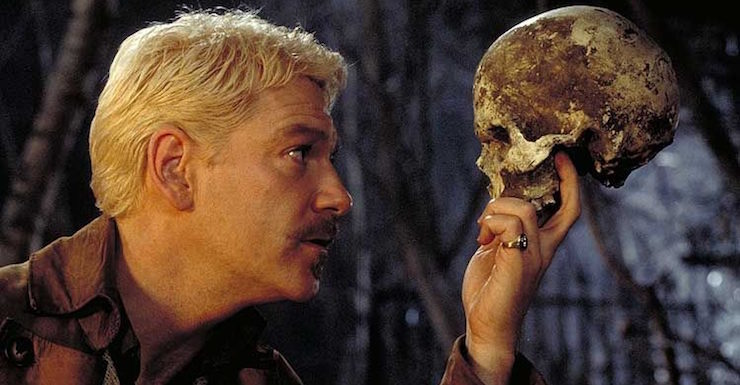
Top image from Branagh’s Hamlet (1996).
This article was originally published in May 2016.
Tessa Gratton has wanted to be a wizard since she was seven. She’s lived on three continents and traveled across more, has a degree in feminism, and once translated her own Beowulf before settling down in Kansas to write and box and create the perfect whiskey cocktail. She’s the author of multiple YA and adult fantasy novels, plus more than a dozen short stories. She is currently a writer for season 2 of Serial Box Publishing’s series Tremontaine. Her novel The Queens of Innis Lear is available March 27th from Tor Books. Find her on Twitter @tessagratton.

I was first introduced to Shakespeare like most American kids – Romeo and Juliet in freshman English. It was terrible. I made it through the rest of the plays we studied – I could read and understand it just fine, but it was SO dry and terrible.
Then, summer between junior and senior year, I stumbled across Live From Lincoln Center’s performance of Twelfth Night on my local PBS station and decided to watch for a bit.
It changed everything I had ever felt or thought of Shakespeare. It was divine. Fast, funny, evocative, titillating, crass, and classy. It was so much fun.
Being able to see a live performance, even a recorded / broadcast live performance I think is essential. The movies can be helpful, but hearing the timing of the jokes, seeing how the actors lean into a line or draw of a phrase as they read the audience, seeing it staged as a play rather then “on location” really makes the difference to me.
I saw an excellent performance of “Romeo and Juliet” at my college, and it blew me away. It was the first time I realized that all the swordfighting in the street was really a bunch of dumb teenagers going too far. (One of the actors actually mooned the audience, in character…) And Juliet was talking to her doll at one point. I don’t remember the second half of the play, but those first moments of introduction really were amazing.
And the 2016 “Shakespeare in the Park” in St. Louis did “A Midsummer Night’s Dream”, one of the best performances I’ve seen there. One thing that really made it special was that Puck was played by… a pair of identical twins! He could run off stage to the side and then instantly appear in the window above! There was some really good crowd reactions from those who hadn’t read the program!
I knew when I was getting old when I decided that the parents in “R&J” weren’t villains, and that those kids were really too young because of their rampant stupidity. Sigh.
The most fun I had in watching productions of Shakespeare in high school or college was figuring out which performers got their British accents from watching Monty Python or their Scottish accents from watching Star Trek.
I loved Bill Murray’s Polonius in the Ethan Hawke Hamlet. He’s lecturing Laertes and Ophelia, being a pain, while all the while caring for them; tying Ophelia’s shoelaces, giving her brother extra money for his journey. He’s the only sympathetic Polonius I have ever seen.
Let’s not forget the Maximilian Schell German version of Hamlet, which MST3K skewered excellently.
I saw something back in the 1990’s that you may enjoy. If I’ve found the right thing it’s called “Playing Shakespeare”, and was done by the Royal Shakespeare Company. It has Patrick Stewart and Judi Dench and many others going very much into detail on how they perform the soliloquies and such.
I had the good fortune to be introduced to Shakespeare at an early age by a performer. My grandfather. Grandpa had a deep, resonate voice and his soliloquies rattled the windows. Nobody has EVER Done ‘to be, or not to be’ like Grandpa. And his Shylock would chill your bones. He also did a fantastic Faust.
I am a huge fan of Branaugh’s productions. I saw Hamlet in a theater, the intermission came after Hamlet’s soliloquy on Fortinbras’s army. The audience sat frozen, still caught in the mood. Then made a mad stampede for the restrooms.
In the late seventies Sir Ian McKellen did an amazing portrayal of Macbeth, esp. the speech quoted above which he gave very quietly though seething underneath. Dame Judi Dench was his Lady Macbeth.
The earliest Shakespeare I remember seeing was Orson Wells version of Macbeth. Good to start but then I saw the comedies and fell in love with the bard. I far prefer them to the tragedies and the histories. The Henry cycle has it’s moments but still, in the end, Much Ado About Nothing or A Midsummer Night’s Dream are far more worth the time to sit and laugh at the foolishness of mankind.
But I have to track a copy of Private Romeo now, thanks for the pointer.
The first time Shakespeare really clicked for me was Branagh’s Henry V. I was in college when it came out, and I’m not even sure what drove me to see it because it was at an inconvenient theater and not the sort of thing I usually would have gone to see. It utterly blew me away, and I went to see it again. It was like the whole story came to life. That’s still one of my all-time favorite movies.
The Romeo and Juliet film I saw in high school had Michael York as Tybalt and Olivia Hussey as Juliet. I didn’t recognize the actor playing Romeo. It’s the Sixties version. When I took Introductory Theater in college we got to drive up to the Ashland Oregon Shakespeare festival. Seeing it live is much different experience and everyone should try it at least once. Personally I was glad we read the Merry Wives of Windsor in class so I could follow along better. I always treat reading Shakespeare like a foreign language it takes a bit for it to click so I can understand it. I still miss a lot of the jokes that are plays on words or phases like “Get the to a nunnery!” doesn’t mean a convent. I’ll have to see if I can find the Tennant performance somewhere it sounds fun.
My first encounter with Shakespeare was in high school — I wrote a report on Julius Caesar based on the summary texts before each scene. But later that year for a field trip we went to the Guthrie in Minneapolis and saw a live performance of … I think it was Twelfth Night? … which was infinitely more enjoyable.
At some point in the mid-1990s I discovered that the public library had VHS copies of most of his plays — the BBC productions from the 1970s; I watched several of them and was generally happy (although Roger Daltry in Comedy of Errors? Really?). Now I own the entire set on DVD, and someday I’ll get back to watching them.
The legendary Japanese director Akira Kurosawa did two takes on Shakespeare; the first being ‘Throne of Blood’ in 1957 as a take on Macbeth, and ‘Ran’ in 1985 for King Lear. Both are excellent, but what I particularly enjoyed about Ran is how it helped me to re-evaluate King Lear, to the point that it is now one of my favorites of the Shakespeare canon.
In Ran, it is heavily implied that in his younger days, Ichimonji (the King Lear analogue), waged constant war to expand his territory. And now, in his old age, he wishes to simply enjoy what he fought so hard for. The film hints at some of the atrocities he committed during his conquest, and how his children (sons instead of daughters in this take), growing up in this environment, perhaps might be simply taking a page from their father’s book in their actions…
The 1993 Branagh adaptation of Romeo and Juliet for BBC Radio 3 – when he chose to filter it through the atmosphere in Belfast during the Troubles? That’s when it finally clicked for me.
Friends of mine live in the UK, and in addition to many many other things have seen both the McKellan Lear and the Tennant Hamlet, and taunted me thereby. I don’t know why I’m still on speaking terms with these people.